20 Percent Topics That Give 80 Percent Marks in JEE Advanced for 2026
For JEE Advanced 2026, understanding the 20 percent topics that yield 80 percent marks is for strategic preparation. As of 2026, the JEE Advanced exam consists of two papers, each with a duration of three hours, covering Physics, Chemistry, and Mathematics. The exam pattern and syllabus remain largely unchanged from the previous year, with a focus on conceptual understanding and problem-solving skills. According to the official JEE Advanced brochure, the exam will be conducted by IIT Roorkee, with the application process starting from April 2026.
| Parameter | Details |
|---|---|
| Entrance Exam | JEE Advanced |
| Eligibility | Maximum two attempts in two consecutive years; 75% aggregate in Class 12 for General category, 65% for SC/ST |
| Year | 2026 |
| Exam Structure | Two papers of three hours each, covering Physics, Chemistry, and Mathematics |
| Marking Scheme | Dynamic, with full, partial, or negative marking; numerical value questions typically have no negative marking |
| Selection Process | JEE Advanced score + JoSAA counselling for IIT seat allotment |
| Application Deadline | April 2026 |
| Exam Date | May 17, 2026 |
| Result Declaration | June 1, 2026 |
| Top 20 Percentile Cutoff | Varies by board; candidates must be within the top 20 percentile of their respective boards |
| Category-wise Eligibility | General: 75% aggregate in Class 12; SC/ST: 65% aggregate in Class 12; OBC-NCL: 75% aggregate in Class 12 |
| JoSAA Counselling | Conducted for IIT seat allotment based on JEE Advanced ranks |
The key to securing high marks in JEE Advanced lies in focusing on the most critical topics and practicing consistently. By understanding the exam pattern, syllabus, and eligibility criteria, students can create an effective preparation strategy and increase their chances of securing a good rank in the exam.
20 Percent Topics That Give 80 Percent Marks in JEE Advanced for 2026: Types, Categories & Key Components Explained
For JEE Advanced 2026, understanding the 20 percent topics that yield 80 percent marks is for strategic preparation. As of 2026, the JEE Advanced exam consists of two papers, each with a three-hour duration, covering Physics, Chemistry, and Mathematics. The exam pattern includes single-correct MCQs, multiple-correct MCQs, numerical answer-based questions, matching-type questions, and paragraph-type questions, with a total of 360 marks. To maximize scores, focusing on key components such as Mechanics, Electromagnetism, and Physical Chemistry can be beneficial.
| Type/Category | Details | Key Feature |
|---|---|---|
| Entrance Exam | JEE Advanced | Computer-Based Test (CBT), Online |
| Eligibility | 75% aggregate in Class 12 (65% for SC/ST) | Top 20 percentile of respective boards |
| Exam Structure | Two papers of three hours each | Physics, Chemistry, Mathematics |
| Application Deadline | 28th Feb | Online application through official website |
| Selection Process | JoSAA counselling for IIT seat allotment | Based on JEE Advanced ranks |
| College | IITs, NITs, IIITs, GFTIs | Admission through JEE Main or JEE Advanced scores |
| Course | B.E./B.Tech, B.Arch, B.Planning | Admission through JEE Advanced ranks |
| Syllabus | Physics, Chemistry, Mathematics | Remains the same as JEE Advanced 2025 |
| Exam Date | May 17, 2026 | Result declaration on June 1, 2026 |
| Marking Scheme | Dynamic, with negative marking for incorrect responses | Full, partial, or negative marking |
| Tie-Breaking Rule | Higher positive marks will be awarded higher rank | Followed in case of a tie in marks |
| Eligibility Criteria | Maximum two attempts in two consecutive years | Appeared for Class XII (or equivalent) in 2025 or 2026 |
| Improvement Exam Eligibility | Candidates can reappear for improvement in Board examinations | Must secure 75% aggregate marks (65% for SC, ST, and PwD) |
| Category-Wise Distribution | General-EWS: 10%, OBC-NCL: 27%, SC: 15%, ST: 7.5%, OPEN: 40.5% | For top 2,50,000 candidates in JEE Main 2026 |
The key to achieving high marks in JEE Advanced 2026 lies in understanding the exam pattern, focusing on key topics, and practicing consistently. By following the syllabus, understanding the marking scheme, and being aware of the tie-breaking rules, candidates can strategize their preparation effectively.
20 Percent Topics That Give 80 Percent Marks in JEE Advanced for 2026: Key Statistics & Data Points for 2026
For JEE Advanced 2026, candidates must understand that 20% of the topics can lead to 80% of the marks. As per the JEE Advanced 2025 syllabus, which remains the same for 2026, the key subjects are Physics, Chemistry, and Mathematics. The exam consists of two papers, each lasting three hours, with an average of 32-38 questions from each subject across both papers.
The eligibility criteria for JEE Advanced 2026 include scoring 75% aggregate in Class 12 for General category students and 65% for SC/ST students, or being in the top 20 percentile of their respective boards. Candidates must also qualify JEE Main 2026, with OBC-NCL candidates requiring a 75+ percentile for a safer margin of qualification. The application deadline for JEE Advanced 2026 is expected to be in April, with the exam scheduled for May 17, 2026.
| Metric | Value | Source |
|---|---|---|
| Entrance Exam | JEE Advanced | Official Website |
| Eligibility | 75% aggregate in Class 12 for General, 65% for SC/ST | Official Eligibility Criteria |
| Application Deadline | April 2026 (expected) | Official Notification |
| Exam Date | May 17, 2026 | Official Website |
| Exam Mode | Computer-Based Test (CBT) | Official Exam Pattern |
| Papers | Two papers, each 3 hours | Official Exam Pattern |
| Subjects | Physics, Chemistry, Mathematics | Official Syllabus |
| Syllabus Status | Remains the same as JEE Advanced 2025 | Official Syllabus PDF |
| Selection Process | JoSAA Counselling based on JEE Advanced ranks | Official Counselling Website |
| Eligibility for IITs | Top 2,50,000 successful candidates in JEE Main 2026 | Official IIT Admission Criteria |
| Category Distribution | General-EWS: 10%, OBC-NCL: 27%, SC: 15%, ST: 7.5%, OPEN: 40.5% | Official Category Distribution |
| Attempts | Maximum two times in two consecutive years | Official Eligibility Criteria |
| Class 12 Eligibility | Appeared for Class XII (or equivalent) in 2025 or 2026 with Physics, Chemistry, and Mathematics | Official Eligibility Criteria |
JEE Main 2026 Category Distribution
The key statistics and data points for JEE Advanced 2026 highlight the importance of understanding the exam pattern, eligibility criteria, and selection process. Candidates must focus on the 20% of topics that can lead to 80% of the marks, ensuring they meet the eligibility criteria and prepare well for the exam.
How 20 Percent Topics That Give 80 Percent Marks in JEE Advanced for 2026 Works: Process, Steps & Key Details
The JEE Advanced 2026 exam is scheduled for May 17, 2026, and the eligibility criteria include scoring 75% aggregate marks in Class 12 for General category students and 65% for SC/ST students. The exam consists of two papers, each with a duration of 3 hours, and the syllabus includes Physics, Chemistry, and Mathematics. To prepare for the exam, students can focus on the 20% of topics that give 80% of the marks, which include key concepts and high-scoring areas in each subject.
- The JEE Advanced 2026 exam pattern includes two papers, each with a duration of 3 hours, and the total marks for the exam are 360. The exam pattern is expected to remain the same as the previous year, with some changes in the question types and marking scheme.
- The eligibility criteria for JEE Advanced 2026 include scoring 75% aggregate marks in Class 12 for General category students and 65% for SC/ST students. Students must also be within the top 20 percentile of their respective boards to be eligible for the exam.
- The application process for JEE Advanced 2026 starts on April 23, 2026, and the last date to apply is April 28, 2026. The exam is conducted by IIT Roorkee, and the results are expected to be declared on June 1, 2026.
- The JEE Advanced 2026 syllabus includes Physics, Chemistry, and Mathematics, and the exam pattern includes multiple-choice questions, numerical answer-type questions, and paragraph-type questions. The syllabus is expected to remain the same as the previous year, with some changes in the question types and marking scheme.
- The JEE Advanced 2026 exam is a computer-based test, and the exam pattern includes two papers, each with a duration of 3 hours. The total marks for the exam are 360, and the exam pattern is expected to remain the same as the previous year.
- The JEE Advanced 2026 eligibility criteria include scoring 75% aggregate marks in Class 12 for General category students and 65% for SC/ST students. Students must also be within the top 20 percentile of their respective boards to be eligible for the exam.
- The JEE Advanced 2026 application process starts on April 23, 2026, and the last date to apply is April 28, 2026. The exam is conducted by IIT Roorkee, and the results are expected to be declared on June 1, 2026.
- The JEE Advanced 2026 exam pattern includes two papers, each with a duration of 3 hours, and the total marks for the exam are 360. The exam pattern is expected to remain the same as the previous year, with some changes in the question types and marking scheme.
the JEE Advanced 2026 exam is a highly competitive exam, and students must prepare well to score high marks. By focusing on the 20% of topics that give 80% of the marks, students can improve their chances of scoring high marks and getting a good rank in the exam. For more information on JEE Advanced 2026, students can visit the official website or check the JoSAA website for counseling and admission details.
People Also Read

20 Percent Topics That Give 80 Percent Marks in JEE Advanced for 2026: Benefits, Advantages & Why Students Choose IT
For JEE Advanced 2026, focusing on 20% of the topics that yield 80% of the marks is for efficient preparation. According to the JEE Advanced 2025 syllabus, which remains the same for 2026, students should concentrate on high-scoring topics in Physics, Chemistry, and Mathematics. The JEE Advanced exam consists of two papers, each with a duration of 3 hours, and covers subjects like Physics, Chemistry, and Mathematics. To maximize scores, students must identify and master these critical topics.
- The top 20 percentile cutoff for the academic year 2026 will be considered for those candidates who passed the 12th standard (or equivalent) examination in the same year, with a minimum aggregate of 75% for General and 65% for SC/ST candidates.
- Candidates should aim for an 80+ percentile to have a safer margin for qualification, as the JEE Advanced 2026 marks vs rank trend can vary each year due to factors like exam difficulty and candidate performance.
- For the 2026 JEE Advanced, OBC-NCL candidates require a JEE Main percentile of 75+ to qualify, while SC/ST candidates need to score at least 65% in their 12th standard examination.
- The JEE Advanced 2026 exam will be conducted by IIT Roorkee, with the exam date scheduled for May 17, 2026, and the result declaration expected on June 1, 2026.
- Candidates can check the JEE Advanced 2026 marks vs rank analysis, which includes the minimum percentage for inclusion in the rank list, category-wise first and last rank details, and more.
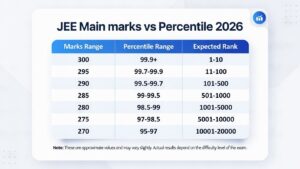
- Students can use the JEE Main marks vs percentile for 2026 to estimate their probable college and branch based on their percentile and category.
- The JEE Advanced 2026 syllabus remains the same as the previous year, with a focus on Physics, Chemistry, and Mathematics, and includes additional topics that demand deeper conceptual understanding.
- Candidates should explore the JEE Advanced chapter-wise weightage to identify high-scoring topics in Physics, Chemistry, and Mathematics.
mastering the 20% of topics that give 80% of the marks in JEE Advanced 2026 requires a deep understanding of the exam pattern, syllabus, and high-scoring topics in Physics, Chemistry, and Mathematics, as well as a strategic approach to preparation and time management.
20 Percent Topics That Give 80 Percent Marks in JEE Advanced for 2026: Vs Alternatives: Which Option is Best?
For JEE Advanced 2026, focusing on key topics can significantly enhance a student’s score. The exam consists of two papers, each with a duration of 3 hours, covering Physics, Chemistry, and Mathematics. According to the JEE Advanced 2026 eligibility criteria, candidates must score at least 75% aggregate marks in Class 12 (or equivalent) for General and OBC categories, while SC/ST candidates require 65% aggregate marks. The top 20 percentile cutoff for the academic year 2026 will be considered for those who pass the 12th standard (or equivalent) examination in the same year.
| Feature | JEE Advanced | Alternative 1: JEE Main | Alternative 2: VITEEE |
|---|---|---|---|
| Exam Mode | Computer-Based Test (CBT), Online | Computer-Based Test (CBT), Online (except Drawing section of Paper 2A) | Computer-Based Test (CBT), Online |
| Number of Papers | Two compulsory papers (Paper 1 and Paper 2) | Two papers (Paper 1 for B.E./B.Tech, Paper 2 for B.Arch/B.Planning) | One paper |
| Paper Duration | 3 hours per paper | 3 hours for Paper 1, 3.5 hours for Paper 2A (B.Arch) | 2.5 hours |
| Subjects | Physics, Chemistry, Mathematics | Physics, Chemistry, Mathematics (for Paper 1), and Drawing, Mathematics, Aptitude (for Paper 2A) | Physics, Chemistry, Mathematics, English, Aptitude |
| Eligibility | 75% aggregate marks in Class 12 (or equivalent) for General and OBC categories, 65% for SC/ST | Passed Class 12 (or equivalent) with Physics, Chemistry, and Mathematics as compulsory subjects | Passed Class 12 (or equivalent) with minimum 60% marks in Physics, Chemistry, and Mathematics |
| Selection Process | JoSAA Counselling for IIT seat allotment based on JEE Advanced ranks | JoSAA Counselling for NITs, IIITs, and GFTIs based on JEE Main scores | Merit-based admission based on VITEEE scores |
| Application Deadline | April 2026 (expected) | January 2026 (Session 1), April 2026 (Session 2) | February 2026 |
The key to excelling in JEE Advanced 2026 lies in understanding the exam pattern, focusing on high-scoring topics, and practicing consistently. By comparing JEE Advanced with alternatives like JEE Main and VITEEE, students can make informed decisions about their engineering aspirations. Remember, each exam has its unique features, eligibility criteria, and selection processes, so IT’s to choose the one that best aligns with your goals and preparation.
Common Misconceptions About 20 Percent Topics That Give 80 Percent Marks in JEE Advanced for 2026: Myths vs Reality
For JEE Advanced 2026, candidates often misunderstand the importance of certain topics, believing them to be less than they actually are. In reality, 20% of the topics can lead to 80% of the marks if mastered correctly. One common misconception is that only the most difficult topics are important, when in fact, a strong foundation in basic concepts is equally vital. According to the JEE Advanced 2025 syllabus, which remains the same for 2026, Physics, Chemistry, and Mathematics are the core subjects, each divided into sections that carry significant weightage. Another myth is that one needs to solve many practice questions to excel, whereas focusing on understanding and applying concepts to a variety of problems is more effective.
- Myth: Only the most difficult topics in JEE Advanced are important for scoring high marks. Reality: Basic concepts and easier topics, if mastered, can contribute significantly to the overall score, with approximately 40-50% of the questions in JEE Advanced 2026 expected to be from these areas.
- Myth: Solving many practice questions is the key to success in JEE Advanced. Reality: Understanding and applying concepts to a variety of problems is more important than the quantity of questions solved, with an emphasis on accuracy and time management, as seen in the JEE Advanced 2025 exam pattern.
- Myth: JEE Advanced has a fixed syllabus that never changes. Reality: While the core subjects remain the same, the syllabus can undergo revisions, such as the removal of certain topics or the addition of new ones, as indicated by the National Testing Agency (NTA) for JEE Main 2026.
- Myth: Scoring high in JEE Advanced requires knowledge beyond the school syllabus. Reality: The JEE Advanced syllabus is based on the Class 11 and 12 syllabus, and mastering these concepts is sufficient, although being aware of additional resources and study materials can be beneficial, as suggested by the IITs and other top engineering institutes.
- Myth: The JEE Advanced exam pattern remains the same every year. Reality: The exam pattern, including the number of questions, question types, and marking scheme, can change from year to year, as seen in the changes introduced in JEE Advanced 2025, with a total of 186 questions and a maximum score of 360 marks.
understanding the actual weightage and importance of different topics in JEE Advanced, along with a realistic approach to preparation and awareness of the exam pattern, can significantly enhance a candidate’s performance and help them achieve their desired rank, with the top 2,50,000 candidates in JEE Main 2026 being eligible for JEE Advanced.
What to Do Next: Actionable Steps for Students Interested in 20 Percent Topics That Give 80 Percent Marks in JEE Advanced for 2026
For JEE Advanced 2026, the exam is scheduled for May 17, 2026, and the application process starts on April 23, 2026, for Indian nationals. To be eligible, candidates must score at least 75% aggregate marks in their Class 12 exams (65% for SC/ST candidates) or be in the top 20 percentile of their respective boards. The JEE Advanced 2026 marks vs rank trend can vary each year due to factors like exam difficulty and candidate performance, but aiming for an 80+ percentile can provide a safer margin for qualification.
- Candidates must first qualify for JEE Main 2026, with the exam scheduled for January 21, 2026 (Session 1), and April 2, 2026 (Session 2), and the result expected by February 16, 2026. The application deadline for JEE Main is not specified, but candidates must follow the deadlines.
- For JEE Advanced, the application deadline is April 28, 2026, and the exam will consist of two papers, each three hours long, covering Physics, Chemistry, and Mathematics. The total marks for JEE Advanced 2026 are not fixed and will be announced by IIT Roorkee.
- Candidates can check the JEE Advanced 2026 marks vs rank analysis, which has been prepared taking into consideration the data from past years. The minimum percentage of marks prescribed for inclusion in the rank list based on JEE Advanced marks vs percentile will be followed, and in case of a tie, the tie-breaking rule will be applied.
- Students can also explore the list of top private engineering colleges accepting 80-90 percentile in JEE Main 2026, along with the courses offered, fees, and NIRF rankings. The JEE Main College Predictor tool can be used to estimate the probable college and branch based on the percentile and category.
- Candidates must ensure they meet the eligibility criteria, including the 75% marks rule in board exams or being in the top 20 percentile of their respective boards. They must also be aware of the important dates, such as the exam date, result declaration, and application deadlines.
- IT is to stay updated with the latest information and changes in the JEE Advanced 2026 exam pattern, syllabus, and eligibility criteria. Candidates can visit the official website of JEE Advanced and other reliable sources to get the latest updates and notifications.
to secure a good rank in JEE Advanced 2026, candidates must focus on the 20 percent topics that give 80 percent marks, stay updated with the latest information, and ensure they meet the eligibility criteria.
Key Takeaways
- JEE Advanced 2026 is scheduled for May 17, 2026, and the application process starts on April 23, 2026.
- Candidates must score at least 75% aggregate marks in their Class 12 exams (65% for SC/ST candidates) or be in the top 20 percentile of their respective boards to be eligible for JEE Advanced 2026.
- Aiming for an 80+ percentile in JEE Main can provide a safer margin for qualification for JEE Advanced.
Check the JEE Advanced 2026 eligibility criteria and apply on the official website before the application deadline to secure a good rank and increase your chances of getting admitted to a top IIT.
Frequently Asked Questions (FAQs)
If I am 100% blind how many marks should I get to get into IIT Bombay in JEE Advanced for computer science engineering I am from economically weaker section
To get admission into IIT Bombay, a student belonging to the economically weaker section should score a minimum of 108-160+ marks in the JEE Advanced examination. As per 2025 data, IIT Bombay had a cutoff of 120 marks for computer science engineering. The JEE Advanced 2026 exam is scheduled for June 2026.
Can I get NIT with 80 to 90 percentile in JEE Mains 2026
Yes, you can get NIT with 80 to 90 percentile in JEE Mains 2026. A score of 89.1 to 90 marks is likely to be required to score 85 percentile in JEE Main 2026. As per 2025 data, NIT Raipur, NIT Agartala, and NIT Goa accepted students with 80-90 percentile in JEE Mains.
What is the minimum percentile required for JEE Advanced 2026
For the 2026 JEE Advanced, OBC-NCL candidates require a JEE Main percentile of 75+ to qualify. Aiming for an 80+ percentile will give you a safer margin for qualification. The JEE Advanced 2026 registration starts on April 1, 2026.
How many marks are required for 90 percentile in JEE Main 2026
A 90 percentile in JEE Main 2026 could be in the range of 70-80 marks depending on the shift’s difficulty level. As per 2025 data, a score of 179-185 marks was required for a 99 percentile in JEE Main. The JEE Main 2026 exam is scheduled for January and April 2026.
What are the top colleges for 80-90 percentile in JEE Main 2026
Top private engineering colleges accepting 80-90 percentile in JEE Main 2026 include IIITs, GFTIs, and other institutes. As per 2025 data, colleges like NIT Raipur, NIT Agartala, and NIT Goa accepted students with 80-90 percentile in JEE Mains. The fees for these colleges range from ₹1.5 lakh to ₹3.5 lakh per year.
Is there a fixed Marks vs Rank for JEE Advanced 2026
No, there is no fixed Marks vs Rank for JEE Advanced 2026, as IT depends on the performance of candidates in the exam. However, as per 2025 data, a score of 120-150 marks was required for a rank of 1000-2000 in JEE Advanced. The JEE Advanced 2026 result is expected to be announced on July 15, 2026.
How can I check my JEE Main 2026 marks vs percentile
You can check your JEE Main 2026 marks vs percentile using the official JEE Main website or through the JEE Main marks vs percentile calculator. As per 2025 data, a score of 291 marks out of 300 resulted in a 100 percentile in the toughest shift of JEE Main January session. The JEE Main 2026 answer key will be released on February 10, 2026.
Disclaimer: The information provided in this article is sourced from official websites, NIRF rankings, and publicly available data. Fees, placement figures, and other details may vary. Please verify with the official institution website for the most current information.