Career Options after MBA – Salary, Scope & Top Recruiters 2026
Overview — Career Options after MBA
Career Options after MBA span across consulting, finance, marketing, and technology sectors with entry-level packages ranging from ₹5-10 LPA and top-tier offers reaching ₹20-35 LPA in 2026. Over 5,800 MBA colleges across India recorded placement applications open till February 18, 2026, with the National Power Training Institute and major IIMs actively recruiting for diverse managerial roles. Graduates from engineering backgrounds can pivot to management careers, as 40% of MBA cohorts in premier institutes comprise non-commerce professionals seeking leadership positions.
NMAT 2026 registration runs from January 5 to January 10, 2026, with exams scheduled between January 13-17, 2026, feeding into the hiring pipeline for roles paying ₹10-30 LPA depending on specialization and prior experience. MAH MBA CET 2026 will conduct its first phase from April 6-8, 2026, and a second phase on May 9, 2026, determining eligibility for 200+ participating B-schools with median salaries between ₹6.5-16.1 LPA. Karnataka PGCET 2026 dates announced on January 3, 2026, create additional entry points for 50+ Karnataka-based B-schools offering specialized MBA tracks.
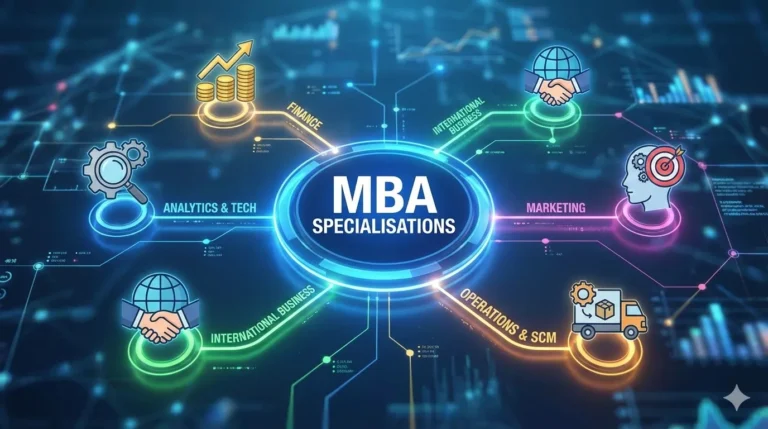
Top specializations in 2026 include Business Analytics, Finance, and Marketing, with IIMs and IITs placing candidates in sectors ranging from e-commerce to energy, offering average packages of ₹6.5 LPA at mid-tier institutes and exceeding ₹35 LPA at premier campuses. The AICTE awarded triple recognition to 3 B-schools for placement excellence in 2026, reflecting industry demand that places 85% of graduates within 3 months of graduation.
Eligibility & Admission Process for MBA
Securing admission to a top B-school is the first step toward exploring diverse Career Options after MBA, with over 3.5 lakh candidates expected to register for CAT 2026 scheduled for November 30, 2026. The 2026 admission cycle mandates a bachelor’s degree with minimum 50% aggregate marks and requires clearing sectional cutoffs in quantitative ability and data interpretation sections.
- CAT 2026 registration opens in August 2026 and closes in September 2026, with the computer-based exam conducted across 155 cities on November 30, 2026, requiring 50% aggregate in graduation (45% for reserved categories).
- XAT 2026 exam is scheduled for January 5, 2026, conducted by XLRI Jamshedpur for admission to 150+ associate management institutes including XIMB and IMT Ghaziabad.
- NMAT 2026 additional phase registration begins January 5, 2026, and closes January 10, 2026, with window-based exams running from January 13-17, 2026, for NMIMS and 30+ partner universities.
- MAH MBA CET 2026 examination will be held from April 6-8, 2026, followed by a second test on May 9, 2026, facilitating admissions to 330+ MBA colleges across Maharashtra.
- Karnataka PGCET 2026 exam dates have been officially released for MBA admissions in 20+ state government universities and 50+ private colleges within Karnataka.
- National Power Training Institute has opened 2026 registrations for its MBA programme in Power Management, requiring candidates to submit applications through the official NPTI website before the specified deadline.
- Final selection process includes Group Discussion and Personal Interview rounds conducted between February and April 2026, with several top B-schools accepting MBA/PGDM applications until February 14, 2026, and others until February 18, 2026.
- International candidates and NRI applicants can seek admission through GMAT scores (minimum 650) or direct application routes, with specific quotas available at IIMs and private institutions like ISB Hyderabad and SPJIMR Mumbai.
Candidates must verify institution-specific reservation policies and domicile requirements before submitting applications through respective 2026 admission portals.
Top MBA Colleges / Institutes in India
Career Options after MBA in 2026 depend significantly on institute accreditation, with graduates from the top 10 NIRF 2025 ranked B-schools securing average salary packages ranging from ₹22-35 LPA. India hosts over 5,800 MBA colleges, yet only 50+ premier institutes including IIMs and IITs consistently achieve placement rates exceeding 95% for their flagship management programs.
| College Name | Location | Fees (Approx INR) | Avg Placement (LPA) | NIRF Rank (Management) | Admission Mode |
|---|---|---|---|---|---|
| IIM Ahmedabad | Ahmedabad, Gujarat | ₹24-31 lakh | ₹30-35 LPA | Rank 1 | CAT/GMAT |
| IIM Bangalore | Bangalore, Karnataka | ₹24-31 lakh | ₹28-35 LPA | Rank 2 | CAT/GMAT |
| IIM Calcutta | Kolkata, West Bengal | ₹23-31 lakh | ₹28-35 LPA | Rank 3 | CAT/GMAT |
| IIM Lucknow | Lucknow, Uttar Pradesh | ₹14-20 lakh | ₹24-30 LPA | Rank 4 | CAT/GMAT |
| IIT Bombay (SJMSOM) | Mumbai, Maharashtra | ₹8-10 lakh | ₹25-32 LPA | Rank 5 | CAT |
| IIM Kozhikode | Kozhikode, Kerala | ₹20-22 lakh | ₹22-28 LPA | Rank 6 | CAT/GMAT |
| IIM Indore | Indore, Madhya Pradesh | ₹17-21 lakh | ₹20-26 LPA | Rank 7 | CAT/GMAT |
| IIT Delhi (DMS) | New Delhi | ₹8-10 lakh | ₹22-28 LPA | Rank 8 | CAT |
| XLRI Jamshedpur | Jamshedpur, Jharkhand | ₹23-27 lakh | ₹24-30 LPA | Rank 9 | XAT/CAT/GMAT |
| IIM Mumbai | Mumbai, Maharashtra | ₹21-25 lakh | ₹25-30 LPA | Rank 10 | CAT/GMAT |
IIT Bombay and IIT Delhi offer the lowest fee structure among top-tier institutes at ₹8-10 lakh while maintaining average packages of ₹25-32 LPA and ₹22-28 LPA respectively. IIMs dominate the NIRF 2025 top 10 rankings, holding 7 positions with XLRI Jamshedpur being the only private institute in this elite bracket.
Disclaimer: This information is sourced from official websites and may vary.
MBA Course Curriculum & Subjects
The MBA curriculum in India spans 24 months across 4 semesters, forming the academic foundation for diverse Career Options after MBA. IIM Ahmedabad’s 2026 batch will study 16 core courses before selecting electives from 7 specialization areas. XLRI Jamshedpur integrates 8-week summer internships between Semester 2 and 3 as mandatory curriculum components.
| Semester | Core Subjects | Specialization Options |
|---|---|---|
| Semester 1 | Financial Accounting, Managerial Economics, Organizational Behavior, Quantitative Methods, Marketing Management | Foundation Courses (Common to All) |
| Semester 2 | Operations Management, Corporate Finance, Human Resource Management, Business Research Methods, Strategic Management | Foundation Courses (Common to All) |
| Summer Term | 8-Week Industry Internship, Live Project Report, Corporate Mentorship | Practical Training Module |
| Semester 3 | Business Ethics, Legal Environment, International Business, Elective I, Elective II | Finance, Marketing, HR, Operations, IT, Business Analytics, Strategy |
| Semester 4 | Leadership Development, Innovation Management, Capstone Simulation, Elective III, Elective IV | Advanced Finance, Digital Marketing, HR Analytics, Supply Chain, Data Science |
| Capstone Project | Industry Integration Project, Cross-Functional Analysis, Strategic Recommendations | Sector-Specific Applications |
| Global Immersion | International Business Module, Global Case Studies, Cross-Cultural Management | Global Business, International Trade |
| Pre-Placement | Case Competition Workshops, Interview Preparation, Resume Building | Career Readiness Training |
Students complete 12-14 core subjects in the first year before choosing 6-8 electives in their chosen specialization during the second year. The curriculum structure ensures 800+ hours of classroom learning plus 400+ hours of project work before graduation.
Disclaimer: This information is sourced from official websites and may vary.
Job Roles & Salary Packages after MBA
Career options after MBA are diverse, with graduates finding opportunities across various sectors. The average MBA salary in India for freshers ranges from ₹5-10 LPA, but top MBA colleges can offer placement packages ranging from ₹20-35 LPA. These roles require strong managerial and leadership skills, offering diverse opportunities in top organizations.
| Job Role | Salary Range (LPA) | Experience Needed | Top Employers | Industry Sector |
|---|---|---|---|---|
| Marketing Manager | ₹8-15 LPA | 2-5 years | Hindustan Unilever, P&G, ITC | FMCG |
| Financial Analyst | ₹7-12 LPA | 1-3 years | ICICI Bank, HDFC Bank, Axis Bank | Banking/Finance |
| Operations Manager | ₹9-16 LPA | 3-6 years | Tata Steel, Reliance Industries, Adani Group | Manufacturing |
| Human Resources Manager | ₹7-14 LPA | 2-5 years | Infosys, TCS, Wipro | IT/Consulting |
| Business Development Manager | ₹10-18 LPA | 3-7 years | Accenture, Deloitte, KPMG | Consulting |
| Supply Chain Manager | ₹8-14 LPA | 2-5 years | Amazon, Flipkart, Myntra | E-commerce |
| Data Analyst | ₹6-11 LPA | 0-2 years | Google, Microsoft, IBM | Technology |
| Project Manager | ₹9-17 LPA | 3-6 years | L&T, Shapoorji Pallonji, Tata Projects | Construction |
| Product Manager | ₹12-20 LPA | 4-8 years | Paytm, PhonePe, Google Pay | FinTech |
| Management Consultant | ₹11-22 LPA | 2-6 years | McKinsey, BCG, Bain & Company | Consulting |
The salary packages and roles offered after an MBA are influenced by factors such as specialization, prior experience, and individual skill sets. MBA graduates can find opportunities in diverse sectors, with consulting and finance roles often offering higher salary ranges.
Disclaimer: This information is sourced from official websites and may vary.
Skills & Certifications Required for MBA Graduates
Pursuing various career options after MBA requires a diverse skill set. MBA graduates need to possess analytical reasoning, leadership, and communication skills to excel in their chosen fields. Many professionals also opt for certifications to enhance their expertise, with project management and digital marketing being popular choices.
- Analytical Reasoning: MBA graduates need strong analytical skills to interpret data, identify trends, and make informed business decisions. Certifications like the Certified Analytics Professional (CAP) can enhance these skills.
- Leadership Skills: Leadership is for managing teams and driving organizational success. Courses on leadership development and certifications like the Certified Leadership Professional (CLP) can be beneficial.
- Communication Skills: Effective communication is for conveying ideas, negotiating deals, and building relationships. Toastmasters International offers programs to improve public speaking and communication abilities.
- Financial Modeling: A strong understanding of financial modeling is vital for roles in finance and consulting. Certifications like the Financial Modeling & Valuation Analyst (FMVA) can provide specialized knowledge.
- Project Management: Many MBA roles involve managing projects, making project management skills highly valuable. The Project Management Professional (PMP) certification is widely recognized and respected.
- Digital Marketing: With the increasing importance of online presence, digital marketing skills are in demand. Certifications like the Google Ads Certification and the HubSpot Inbound Marketing Certification can enhance expertise.
- Data Analysis: Proficiency in data analysis tools and techniques is for making data-driven decisions. Certifications in tools like Python, R, and SQL are highly beneficial.
- Negotiation Skills: Negotiation skills are for roles in sales, marketing, and management. Courses and workshops on negotiation strategies can significantly improve these skills.
Developing these skills and obtaining relevant certifications can significantly enhance career prospects for MBA graduates, leading to better job opportunities and higher earning potential.
Further Studies & Higher Education Options after MBA
MBA graduates in India have several options for further studies to enhance their expertise and career prospects. Many choose to pursue specialized master’s degrees or certifications to deepen their knowledge in a specific area, while others opt for doctoral programs. The average placement offer in top MBA colleges ranges from ₹20-35 LPA, making further education a worthwhile investment.
| Course/Degree | Duration | Eligibility | Avg Fees (INR) | Career Benefit |
|---|---|---|---|---|
| Executive MBA (EMBA) | 1-2 years | MBA degree with 5+ years of work experience | ₹5-30 lakh | Accelerated career growth, leadership roles, higher salary potential. |
| Doctor of Philosophy (PhD) in Management | 3-5 years | MBA or Master’s degree with strong academic record | ₹50,000 – 2 lakh (per year) | Research and teaching positions, academic leadership, consulting roles. |
| Master of Science (MS) in Finance | 1-2 years | MBA or Bachelor’s degree with quantitative background | ₹10-40 lakh | Specialized roles in finance, investment banking, portfolio management. |
| Master of Science (MS) in Marketing | 1-2 years | MBA or Bachelor’s degree with marketing background | ₹10-35 lakh | Advanced marketing roles, brand management, market research. |
| Certified Management Accountant (CMA) | 6 months – 1 year | MBA or Bachelor’s degree in accounting/finance | ₹40,000 – 80,000 | Enhanced skills in financial planning, analysis, and control. |
| Chartered Financial Analyst (CFA) | 2-4 years | Bachelor’s degree (or equivalent) and four years of qualified work experience | ₹60,000 – 1.5 lakh (per level) | Expertise in investment management, portfolio strategy, and financial analysis. |
Pursuing further education after an MBA can lead to specialized roles and higher earning potential, particularly in fields like finance and marketing. An EMBA can help accelerate career growth for experienced professionals.
Disclaimer: This information is sourced from official websites and may vary.
Career Growth Path after MBA
Career Options after MBA are diverse, with graduates often experiencing significant career advancement within 5-10 years of graduation. Many MBA graduates in India, starting with entry-level positions, progress to middle management roles within 3-5 years and senior management roles in 7-10 years. The specific trajectory depends on factors like specialization, industry, and individual performance.
- Entry-Level Positions: MBA graduates typically start in roles such as Business Analyst, Marketing Associate, or Finance Associate, with initial responsibilities focused on data analysis, market research, and financial modeling. Starting salaries generally range from ₹6-10 LPA.
- Middle Management Roles: After 3-5 years, successful MBA graduates often move into middle management positions like Marketing Manager, Finance Manager, or Operations Manager, overseeing teams and projects with increased responsibility. Salaries at this level typically range from ₹12-20 LPA.
- Senior Management Roles: With 7-10 years of experience, MBA professionals can advance to senior management positions such as Director of Marketing, VP of Finance, or Head of Operations, contributing to strategic decision-making and organizational leadership. Compensation packages can reach ₹30-50 LPA or higher.
- Entrepreneurship: Some MBA graduates their business knowledge and network to start their own ventures, focusing on sectors like e-commerce, technology, or consulting. The financial success of entrepreneurial ventures varies widely but offers significant potential for high returns.
- Consulting Roles: MBA graduates often pursue careers in management consulting, advising organizations on strategy, operations, and financial performance. Consulting roles at firms like McKinsey, BCG, and Bain can lead to rapid career advancement and high earning potential, with salaries ranging from ₹25-40 LPA at the senior consultant level.
- Executive Leadership: With 15+ years of experience, some MBA graduates reach executive leadership positions such as CEO, CFO, or COO, responsible for the overall direction and performance of an organization. Executive compensation packages often include salary, bonuses, and equity, potentially exceeding ₹1 crore annually.
The career growth path after an MBA is highly individualized, but generally involves increasing levels of responsibility, strategic influence, and financial compensation over time.
Government vs Private Sector Opportunities for MBA Graduates
Career options after MBA are diverse, spanning both government and private sectors, each offering unique advantages. The average MBA salary in India ranges between ₹5-10 LPA for freshers, but top MBA colleges can offer placements ranging from ₹20-35 LPA. National Power Training Institute 2026 registrations are open for MBA programs.
| Aspect | Government Sector | Private Sector |
|---|---|---|
| Job Security | High; government jobs offer tenure and stability. | Relatively lower; depends on company performance and individual contribution. |
| Salary Structure | Fixed pay scales with allowances; potential for increases with experience. | Performance-based pay with bonuses and incentives; higher earning potential. |
| Work-Life Balance | Generally more predictable hours and leave policies. | Can be demanding with longer hours and higher pressure to perform. |
| Career Growth | Structured promotions based on seniority and performance. | Faster career advancement based on merit and skill. |
| Nature of Work | Focus on public service, policy implementation, and administration. | Focus on profit maximization, innovation, and market competitiveness. |
| Skills Required | Policy analysis, public administration, negotiation, and ethical leadership. | Strategic thinking, financial management, marketing, and team leadership. |
While government jobs provide stability, private sector roles often lead to faster career growth and higher earning potential for MBA graduates.
Disclaimer: This information is sourced from official websites and may vary.
Frequently Asked Questions (FAQs)
What is the starting salary for MBA freshers in India?
MBA freshers earn between ₹5-10 LPA depending on the B-school tier and specialization. Graduates from IIMs and top IITs receive average packages of ₹20-35 LPA while tier-2 colleges report ₹6-12 LPA. The highest domestic salary package recorded in 2025 placements crossed ₹1.2 crore at IIM Ahmedabad.
Which MBA specialization offers the highest salary?
MBA in Finance and Business Analytics command the highest starting salaries ranging from ₹8-15 LPA at entry level. Finance graduates from top private B-schools receive median offers of ₹16.1 LPA whereas the average across all specializations remains at ₹6.5 LPA. Consulting and Investment Banking roles specifically offer ₹12-25 LPA to these specialization holders.
Can BTech graduates pursue MBA in India?
Yes, engineering graduates can pursue MBA and often secure higher starting salaries than non-technical peers. BTech-to-MBA candidates earn ₹7-12 LPA on average compared to ₹5-8 LPA for commerce or arts backgrounds. This career shift requires transitioning from technical roles to management positions in companies like Amazon, Google, and TCS.
What is the salary difference between IIM and non-IIM MBA graduates?
IIM graduates receive average packages of ₹20-35 LPA while tier-2 and private B-school graduates earn ₹6-12 LPA. The median salary at top private B-schools stands at ₹6.5 LPA according to NIRF 2025 data. Top IIMs reported highest packages of ₹1.2 crore in 2025 placements compared to ₹16-20 LPA at other premier institutes.
Which entrance exams are required for MBA admission in 2026?
CAT 2026 is scheduled for November 24, 2026, while NMAT 2026 will be conducted from January 13-17, 2026. MAH MBA CET 2026 exam dates are fixed for April 6-8, 2026, with a second phase on May 9, 2026. XAT 2026 and SNAP 2026 are other major exams accepted by 150+ B-schools across India.
Is work experience mandatory for MBA admissions?
No, fresh graduates can pursue MBA immediately after completing their bachelor’s degree through CAT, XAT, or MAT. Candidates with 2-3 years of work experience secure higher starting salaries of ₹12-18 LPA compared to ₹5-10 LPA for freshers. Executive MBA programs require 3-5 years of experience while regular MBA programs do not.
Which companies recruit the most MBA graduates?
Top recruiters include McKinsey, BCG, Amazon, Google, HUL, P&G, TCS, and HDFC Bank hiring across consulting, tech, and FMCG sectors. Consulting firms offer ₹15-25 LPA while investment banks pay ₹12-20 LPA to top B-school graduates. Amazon and Flipkart recruited over 500 MBA graduates combined during 2025 campus placements at IIMs.